Showing posts with label Thinking Pug. Show all posts

12 November, 2010

Who Is Getting Up?


I've recently signed up to a number of email newsletters from across the political spectrum, so I can have a look at the sorts of communication different groups put out.

One of these groups is 'GetUp!', which is, according to its website, "an independent, grass-roots community advocacy organisation giving everyday Australians opportunities to get involved and hold politicians accountable on important issues."

There are strong elements of populist rhetoric on their website and across their communications. While 'populist rhetoric' might sound an alarming or derogatory label, it simply refers to a discourse which centres upon the actor or central figure of 'the people' - a homogenous, virtuous group sharing common views and opinions.

'The people' are usually at danger of having their voice suppressed by others. In the discourse adopted by GetUp, the people must have their voice heard so that the democratic process can occur unimpeded.

Their very name, 'GetUp!' is a call to 'progressive' Australians to stand up and take action on a range of issues. GetUp collected data informs us that their supporters are people concerned about climate change, asylum seeker and refugee rights, water, renewable energy, and healthcare.

This data helps make clear exactly what the term 'progressive Australians' means when used to describe 'the people' GetUp represents.

GetUp asserts that the organisation is "not for profit and receives no money from any political party or the government. We rely solely on funds and in-kind donations from the Australian public."

In this sense, GetUp posits itself as a conduit for progressive Australians, which, through advertisements, online campaigns, and petitions, can help citizens engage with their politicians. It helps them have their voice heard.


Another populist group active in Australian politics (which I stumbled upon during a uni assessment) is the Australian Tea Party.

Unlike GetUp, which claims to represent progressive Australians, The Australian TEA Party writes that "We unite behind three main concepts: Free Markets, Fiscal Responsibility, Constitutionally Limited Small Governments."

A smaller afterthought notes that "Individual freedom is of course assisted by following these 3 concepts."

However, while 'progressive' is different to 'small government' in focus, the populist elements remain the same. The Australian TEA Party is "a grassroots citizen empowerment movement". It knows that you feel as though you have "lost your voice", and that "real choices that would actually work - making life better - are never presented" in contemporary politics.

Interestingly, on both of the websites for these groups is the symbol of stars, reminiscent of the Australian flag. Both of these groups suggest that they represent Australians.

They are both speaking on our behalf, both claiming to be organisations belonging to us, yet they have very different ideas about what we want.

So, which of them is right?

There is a dichotomous distinction which is usually made when labelling or discussing populist groups. They may be deemed true grassroots movements, set up by a number of concerned citizens to deal with issues which are important to them.

Or it may be what is called 'astroturfing', or falsely claiming to originate from the ordinary public, when in fact the group is carefully managed by one or several businesses (or politicians, other bodies with ample funding behind them), and has the aim of dealing with issues important to these businesses through the voice of 'the people'.

E.g., it is much more convincing to have a grassroots movement of citizens advocating that we should stop being mean to banks, than to have banks tell us to stop being mean to them.

GetUp certainly has a stronger claim to be able to speak for their more targeted demographic of progressive Australians. Petitions are supported by these people, and campaign videos virally distributed by them. In this way, GetUp is closely involved with its 'people'.

The Australian TEA Party's legitimacy as a representation of people's views is not as transparently displayed on their website, with a general sense of all-encompassing inclusivity attempting to sweep the reader up. It might be reasonably speculated that this is an astroturf group, supported and perhaps managed by businesses and banks who would very much like to be less regulated and monitored by government. But we cannot be sure.

This is why populist rhetoric is something like ventriloquism. People speaking on 'our' behalf put across 'our' point of view. Imitating 'our' voice. The danger being, of course, that the many groups 'speaking on our behalf' might prevent us from actually being heard.

The similarities and differences in both of these groups shows that pointing the finger at an argument and labelling it 'just populism' fails to appreciate the complexities of populist rhetoric. Like clothing, it may be used to dress up arguments and give them authority or the backing of the Australian people/battlers/progressive Australians/fair dinkum Aussies.

But it is not an evil in itself.

It is the ends to which it its immense motivational power is harnessed which must be examined. And most importantly, who is channelling the voice of the people?
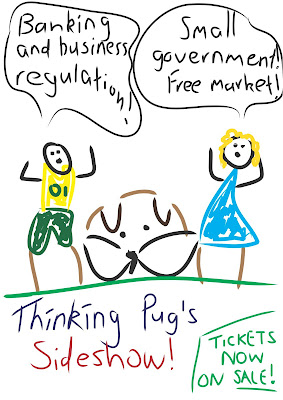
Tickets for Thinking Pug's hilarious 'Puppetry of the People' cost $550 for adults, $549 for concession, and go on sale next March.

30 October, 2010

Daytime TV

Daytime television nearly always leaves me feeling depressed, confused, and upset at the hours I have lost watching it.

And so the last time I was watching, I decided that it was time to get to the bottom of why.

The reason became patently clear once I started actually looking for it. It isn’t the programming, even though the mildly amusing 80s American ‘thrillers’ enjoy a more privileged midday movie position than they should.

The reason is what goes in between the programs.

It’s the ads.

Ads in different timeslots address us differently. During Masterchef, we might be bombarded with ads encouraging us to incorporate Western Star butter into our culinary adventures, or to use Handee Ultra when we (or our exceptionally gifted children) make a mess in the process of crafting the perfect chocolate fondant.

But daytime television ads are different. These are just some of the things they tell us:

- You are flabby, and need to purchase an Ab-Pro or similar to tone your body

- You are fat, and need to join Weight Watchers to lose the weight and keep it off

- You are too hairy, and need to go to a painless laser place to remove unwanted hair

- You are going bald, and need to visit Ashley and Martin (I’m never sure whether this name is the two surnames of the business partners, or the first names of a homely couple who run a pretty slick hair regrowth clinic)

- You have bad teeth – they are either too sensitive, and you need Sensodyne (advertisement complete with erratic camera cuts), or they are yellow and unattractive, in which case you need a UV whitening light (a solarium for your mouth? Sure, sounds harmless enough)

- You need Foxtel, because the fifteen or so free to air channels are not enough to satisfy your endless search for mind-numbing content. Also, your life will revolve around recording, re-watching, replaying and basically living off, your new Foxtel channels

- You are involved in a lengthy and very costly legal struggle, and require some ‘no win, no cost’ lawyers to help you out with an obligation free phone call

- Your skin is too pale; you need to tan up either with a spray, lotion, or good ole’ solarium

- You have severe acne which is inhibiting your life – you must use the same thing that Delta Goodrem used

- You are in severe debt, and it is time to call a helpline

When I’m pummelled with these ads during the day, I begin to feel sick. I feel that my life is wasting away in front of the television. How will I foot the bills for the arduous legal battle I’m embroiled in anyway?

By addressing us with these messages, the advertisements attempt to shepherd people into the respective roles, and it is this that depresses me.

The final message is, perhaps, all things considered, the kindest one.

Having constructed daytime TV watchers as balding, pasty, chubby, legally hopeless, hairy, gat toothed, debt-ridden, afflicted individuals, the advertisements at least have the mercy to remind us that we will probably die soon.

Grandparents, ruffling a small child’s hair before staring down the camera and smiling serenely as they say,

“We love to keep active and enjoy life. But we know we won’t be around for much longer.”

Then some crisp, suited up woman usually spring in and starts spruiking a funeral plan or life insurance scheme that will mean no family has to bear the financial burden of all the funeral costs. It is always entertaining to watch them attempt to make the proposition of “if you give me your money now, I will help pay for your funeral later” sound tasteful.

And that is why I don’t like daytime TV.


03 October, 2010

AFL and War: Let's Make a Comparison


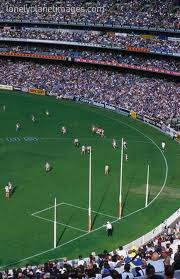
One of the footballers said, after the draw last Saturday, "It was war today, and it's not too often you come back and fight a war a week later, but we're up for it."

Mmm, grassy.

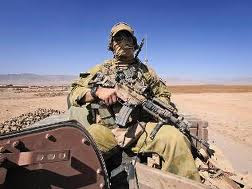
Afghanistan

This is no new analogy. AFL is frequently referred to in terms of battles, heroes, casualties, carnage, etc.

The media loves to hype up just how much all Melbournians love the football. And by writing and exposing us to pieces on how football is our religion, or how the only thing that people will judge you by is your AFL team loyalties, these trends (if they ever existed) are strongly reinforced.

My tutor from last Semester suggested that sports are some sort of 'war substitute', which satiate some sort of inherent human desire for conflict, presumably analogous to the 'hate speech' in 1984.

But this becomes confusing if we consider that we have no need for a substitute - Australia is involved in wars already. Why don't people follow the conflict in Afghanistan with the same zeal and passion that they follow the battles, triumphs, and losses of their chosen football teams?

I guess it's because

a) Nobody knows who the sides are
b) Nobody knows anything

I feel so unable to comprehend any of it - sure, I might know that Hamid Karzai is the current Prime Minister, and that the Taliban are still preventing stable governance. But how can I possibly hope to really know anything? All I know are words and figures. They mean little. I read this fascinating interview with Australian journalist Michael Ware, who has spent many years in Iraq, as well as Afghanistan.

He describes the lives of people in Australia (and, I suppose, all people living in affluent nations) as "a bubble floating on the sea of humanity", and notes that once he left it, he is unable to step back inside it in the same way.

I sometimes wonder whether I want to be able to step out of the bubble, and die having known what people are, what they do, why they do it.

And I think that this is why it is so ridiculous to compare football with war. Most people making the comparison have never been on a battlefield. Everything I read about war and violent conflict seems to agree upon the random way in which life and death are handed out.

Nobody goes into a football field expecting they might die. Football is so securely entrenched within the bubble - in a bubble of advertising for sponsors, of team colours, umpires who can stop the 'battle' with a blow of a whistle, and an audience who can actually see and know exactly what goes on on the battlefield.


...and perhaps we would care about them when they did happen.

04 September, 2010

The Competence Facade

The competence facade is a something which a part of my mind is always working at maintaining. I've come to understand that it relies largely on the amount of energy available. When energy levels are generally high, the competence facade is comfortably maintained. More or less, I'll find myself offering upbeat, positive, 'I got my stuff together' statements.


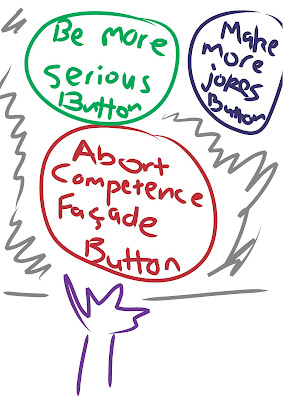
However, the more tired I become, the less expendable energy there is to regulate this, which I can only presume inevitably leads to this exchange between the small cerebral denizens who decide how power is allocated to different brain processes:

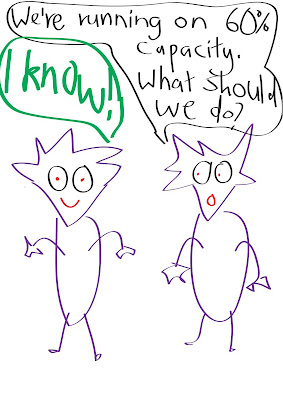
"We're running on reduced processing power, what should we do?"

"We need to cut power from somewhere...I guess we'll do the usual?"

"Yep, bring down the competence illusion."

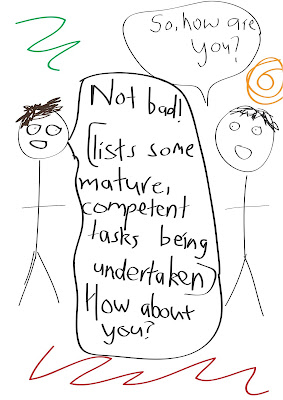
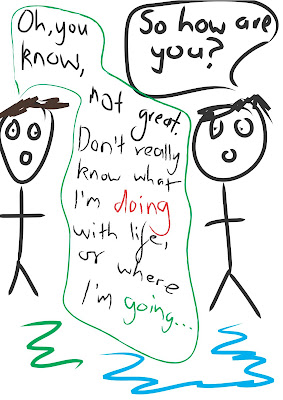
After this, the response to that conversational staple question, "How are you?", can be a very different one:


And the asker is left trying to figure out the best way to extricate themselves from a terrifying monologue of raw emotional and psychological anxiety that should never have seen the light of day (or the light of polite conversation, at least).

On lowered energy, I no longer believe I am competent. I no longer care if I am seen as competent. I cease to trust myself to run my own life, and begin to doubt every decision I have made thus far.

I am overwhelmed with the desire to be a child again, tucked up warm and safe in bed, knowing that the big world out there is out of my control, and I don't need to worry about it.

So usually I do just that, until I have slept well enough that my mind can re-assemble the facade, and 'competent' mental governance of my life can resume.


14 August, 2010

No, I'M the underdog!

Apparently Tony Abbott believes he is the underdog/battler/David against Goliath.

He's also "pleased and proud to be leading a team which wants a better style of politics in Australia and certainly we'll keep running the kind of campaign you've seen over the past few weeks."


Good for him.